Protecting Anza-Borrego from the Golden Pacific Powerlink
A 500,000kV Threat to California’s Largest State Park
A massive new transmission line is being planned through the heart of Anza-Borrego Desert State Park — and right now, the public has a
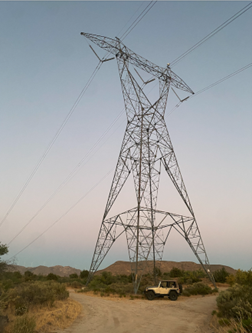
meaningful opportunity to help inform the process. The Golden Pacific Powerlink is a proposed 500-kilovolt (kV) high-voltage transmission line that would run approximately 135 miles from the Imperial Valley Substation in southern Imperial County to the border of San Diego and Orange Counties, near the decommissioned San Onofre Nuclear Generating Station. If built along its currently anticipated route, the line would cut directly through Anza-Borrego — through designated wilderness, cultural preserves, and some of the most ecologically sensitive landscapes in Southern California.
SDG&E released a proposed route map on April 13, 2026 and is accepting stakeholder feedback through early November 2026. The formal California Public Utilities Commission (CPUC) application is expected later this year, at which point a multi-year state and federal environmental review process will begin. This stakeholder feedback period — right now — is when awareness and engagement can help shape the project before it reaches formal regulatory review.
Anza-Borrego Foundation is working to ensure people understand what is being proposed and how to engage. We need your voice, too.
The Golden Pacific Powerlink is one of the largest and most expensive transmission projects in California’s current grid planning — estimated to cost ratepayers $2.3 billion. It was identified in CAISO’s 2022–2023 Transmission Plan as essential for grid reliability, clean energy integration, and reducing congestion across Southern California’s electrical system.
In practical terms, a 500 kV line is the highest-voltage class of transmission infrastructure built in California. The towers required to carry these lines can stand 150 to 200 feet tall, the height of a 15- to 20-story building with a cleared right-of-way stretching hundreds of feet wide. For context, the only existing transmission line within the Park today is a 69 kV line on modest wooden poles, barely visible against the landscape. That line was constructed before the Park was established in 1933 and before the California Environmental Quality Act (CEQA) existed (1970) — it would not be permitted today.
The scale of what is proposed is of a completely different order.
May 2023: CAISO’s Board of Governors approves the 2022–2023 Transmission Plan, affirming the need for a new 500 kV line from southern Imperial County to northern San Diego County. The project — formally called the Imperial Valley to North of SONGS (IVNoS) 500 kV line — is the single largest and most expensive project in the plan.
May 2024: CAISO publishes its selection report, naming Horizon West Transmission, LLC as the approved Project Sponsor to build, own, and operate the line.
August 2025: SDG&E assumes responsibility for the transmission line portion of the project from Horizon West. SDG&E will build, own, and operate the line. Horizon West retains the substation component near San Onofre. SDG&E brands the project the “Golden Pacific Powerlink.”
April 2026: SDG&E releases its preliminary route corridor map for stakeholder feedback, showing the corridor passing directly through Anza-Borrego Desert State Park.
May 12 and 14, 2026: SDG&E hosts virtual open houses at 12 p.m. and 5:30 p.m. All sessions present the same content.
Summer/Fall 2026: SDG&E hosts in-person open houses (specific dates to be announced). Stakeholder feedback period remains open through early November 2026.
Fall/Winter 2026: SDG&E files its formal application with the California Public Utilities Commission (CPUC).
Fall 2026 – Fall 2029: State and federal environmental review and permitting process, including CEQA and NEPA analyses, public participation hearings, and agency review.
Fall 2029: Construction projected to begin, pending approvals.
2032: New transmission line projected to begin service.
SDG&E has stated that there is no other feasible route for this project — that the line must go through the Park. The application materials submitted to CAISO describe a route that would pass directly through Anza-Borrego Desert State Park for a significant portion of its length. The applicant has indicated the route would follow existing roads and transmission infrastructure within the Park to “minimize impacts” — but the areas in question include:
- Scenic Highway 78, one of the most iconic and heavily traveled routes through the Park
- Tamarisk Grove Campground, a beloved and well-used campground at the junction of Highway 78 and the Great Southern Overland Stage Route
- Grapevine Canyon, a significant ecological and scenic corridor
- Angelina Spring Cultural Preserve, a protected area safeguarding irreplaceable indigenous cultural resources
The proposed route would expand the existing narrow utility right-of-way that currently carries the small 69 kV line into something unrecognizable — a cleared industrial corridor carrying one of the most powerful transmission lines in the state through the middle of a protected landscape.
Beyond the Park: A Corridor Crossing Three Counties
Anza-Borrego is not the only landscape affected. The preliminary route corridor, as shown in SDG&E’s April 2026 fact sheet, continues begin in Imperial County southeast of the Park, running northwest from the Park across rural San Diego County and into Riverside County, passing through or near:
- Lake Henshaw and the surrounding watershed
- Warner Springs, a small historic community in northeastern San Diego County
- Palomar Mountain communities, including areas around Palomar Mountain State Park and the Palomar Observatory region
- Pala, Pauma Valley, Rincon, and Valley Center, including tribal lands and rural residential communities
- Temecula and the Pechanga area in southwestern Riverside County
- Agricultural landscapes, tribal reservations, and scenic rural areas along the full length of the corridor
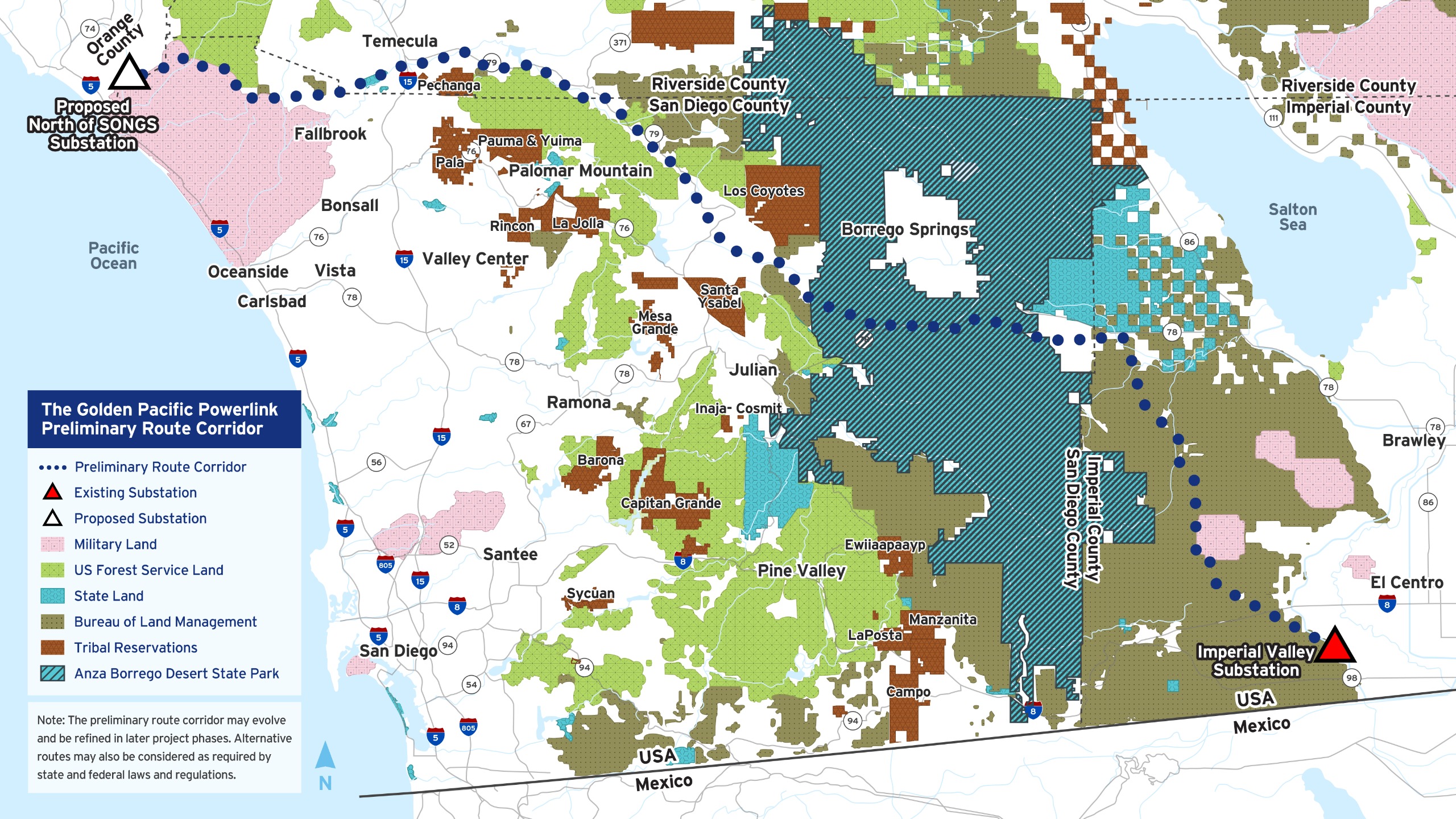
Each of these communities will have its own concerns, history, and stake in the process. The impacts of this project extend well beyond Anza-Borrego, and a thoughtful, transparent stakeholder process must account for the full breadth of what is being proposed.
When CAISO included this project in its 2022–2023 Transmission Plan, one of the stated justifications was to “unlock access to renewable generation resources to meet state energy needs.” CAISO’s own planning documents describe the southern California 500 kV corridor as providing access to Imperial County and Arizona solar generation, Imperial Valley geothermal, and New Mexico wind generation.
When SDG&E publicly announced the project in August 2025, the company’s press release explicitly stated the project was “essential for California to achieve its ambitious carbon reduction goals” and would help “integrate more clean energy.”
But SDG&E’s April 2026 public fact sheet — the document now being presented to communities and stakeholders — tells a different story. The clean energy and renewable integration language has largely disappeared. The fact sheet describes the project’s purpose in source-neutral terms: meeting growing demand, improving reliability, and enabling “greater integration of more electricity generation” — with no mention of what type of electricity.
This matters. A 500 kV transmission line is a physical wire. Once constructed, it can carry electricity from any source connected to it — renewable or fossil. There is no regulatory requirement in any of the project’s public documentation that commits this line to carrying clean energy. The project was justified in part by its potential to enable renewable integration, but there is no binding commitment that it will be used for that purpose.
If a project is being advanced through one of California’s most protected landscapes on the premise that it serves the state’s clean energy future, where is the commitment that guarantees that outcome?
This is a legitimate question for SDG&E, for CAISO, and for the CPUC — and it is one that stakeholders can and should raise during this feedback period.
Transmission lines do not exist in isolation. Once a major high-voltage corridor is established, it becomes an economic and regulatory magnet for further industrial development, additional substations, utility-scale solar and wind facilities, access roads, switchyards, and staging areas. The line itself is often the seed for a much larger footprint of industrial energy development along its length.
The Sunrise Powerlink precedent is instructive. After that line was built in 2012, what followed included:
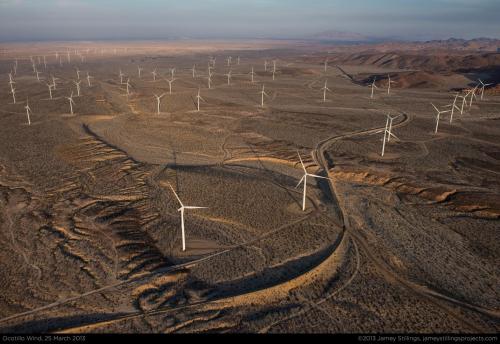
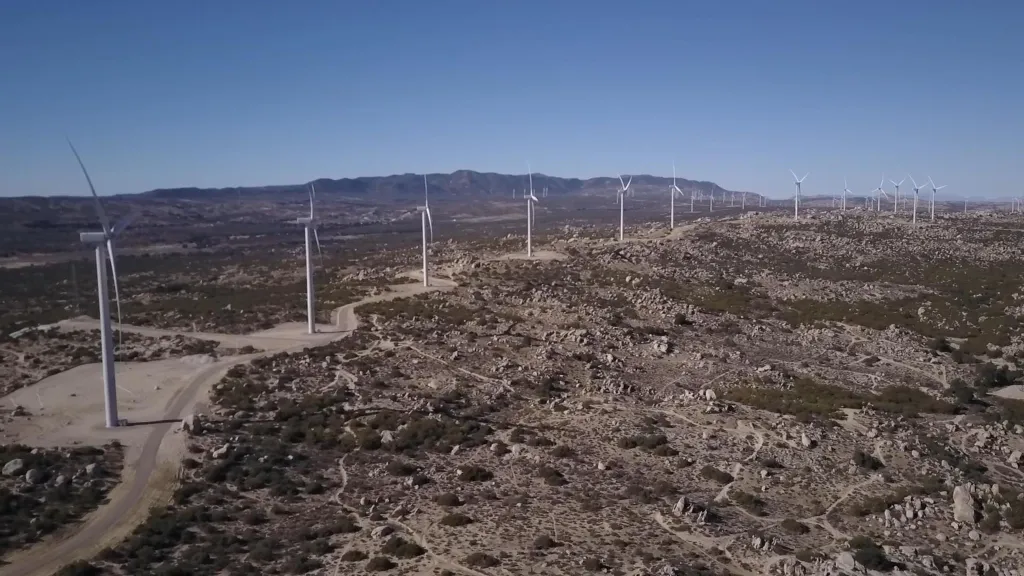
- Ocotillo Express Wind Facility — 112 industrial wind turbines, each approximately 450 feet tall (comparable to 40-story buildings), sited on more than 10,000 acres of public desert land near Anza-Borrego, with in its viewshed at the southern end of the Park. SDG&E described Ocotillo at the time as “precisely the type of project the Sunrise Powerlink was designed to support” and pointed to it as the first of “more than a half dozen” renewable projects planned to interconnect with the line.
- Tule Wind Project — A 200 MW wind facility in McCain Valley, designed to connect to the Sunrise corridor. To accommodate it, the Bureau of Land Management downgraded the area’s Visual Resource Management Classification from Class II to Class IV — a substantial reduction in visual protection standards.
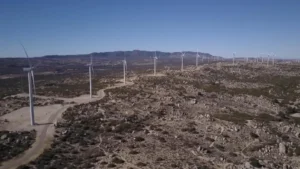
Photo: San Diego Union Tribune
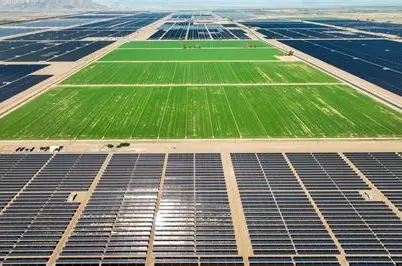
- Imperial Valley solar development — Multiple utility-scale solar facilities clustered around the Imperial Valley substation at the Sunrise line’s eastern terminus, transforming thousands of acres of desert into industrial generation sites.
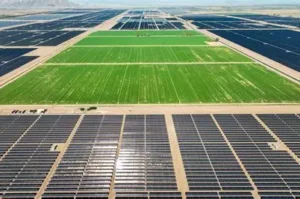
Photo: LA Times
- Corridor expansion mechanisms — Federal designation as a regional power corridor can allow an initial 200-foot easement to expand up to 3,000 feet. Once a corridor exists, the framework to broaden it exists with it.
- And there are still more being built and proposed along the Sunrise today, currently piecemealing the destruction of our backcountry ecosystems and communities.
These are not abstract concerns. They are the documented pattern of what follows a major transmission line in this region.
It is also worth noting that Pattern Energy, the developer behind the Ocotillo Wind Facility, operates through a subsidiary called Horizon West Transmission LLC. Horizon West Transmission is the same entity CAISO originally approved as the project sponsor for the Golden Pacific Powerlink, before SDG&E assumed responsibility for the transmission line portion in August 2025. The corporate network positioned to benefit from follow-on industrial development along the Golden Pacific Powerlink corridor is, in significant part, the same one that built Ocotillo Wind along the Sunrise Powerlink corridor.
Approval of a 500 kV transmission line through the Anza-Borrego region is not just a decision about a single line. It is a decision about establishing a new industrial energy corridor across rural San Diego County and into Riverside County — with its own attendant economic and regulatory gravity that will pull additional industrial projects into its orbit. That broader pattern deserves honest public acknowledgment as part of this stakeholder process.
Wilderness and Ecological Integrity
Anza-Borrego Desert State Park encompasses over 650,000 acres — larger than the state of Rhode Island — with approximately 85% of the Park designated as wilderness, representing California’s highest level of conservation protection. It is the most biodiverse park in the California State Park system and a cornerstone of the state’s 30×30 initiative to conserve 30 percent of California’s lands and coastal waters by 2030. It is one of the last places in Southern California where an entire desert ecosystem still functions at landscape scale, unbroken by development.
A 500 kV transmission line through the Park would fragment that continuity. Construction would require heavy equipment access, grading, tower foundation excavation, and permanent access roads through terrain that has been deliberately protected from exactly this kind of disturbance. The cleared right-of-way would create a linear scar visible for miles across the open desert landscape.
Endangered and Sensitive Species
The Park provides critical habitat for the Peninsular bighorn sheep (Ovis canadensis nelsoni), a federally listed endangered species. These animals depend on intact terrain, unobstructed movement corridors, and undisturbed access to water sources. A transmission line corridor would introduce permanent barriers and disturbance into habitat essential for their survival.
Anza-Borrego also supports over 50 species of reptiles — the richest concentration in California — along with desert kit fox, mountain lion, golden eagle, and numerous species found nowhere else in the world. The Park’s springs and seasonal water sources are biodiversity hotspots that anchor the entire desert food web.
Cultural and Paleontological Resources
The lands through which this line would pass hold deep cultural significance. Indigenous peoples — including the Kumeyaay (Ipai, Tipai, and Kamia), Cahuilla, and Cupeño nations — have shaped and inhabited this landscape for millennia. The Angelina Spring Cultural Preserve, directly in the path of the proposed route, exists specifically to protect these irreplaceable cultural resources.
The Park’s badlands also preserve one of North America’s richest concentrations of Pleistocene-era fossils, with over 550 documented types of fossil plants and animals spanning more than two million years. Construction disturbance in fossil-bearing formations could destroy resources that have not yet been discovered.
Dark Sky Protections
Anza-Borrego is designated as an International Dark Sky Park — a recognition of the exceptional quality of its night skies and the community’s commitment to preserving natural darkness. High-voltage transmission infrastructure introduces lighting, electromagnetic interference, and industrial presence that directly undermine dark sky values and the nocturnal wildlife behavior that depends on them.
Economic Impact to the Region
The community of Borrego Springs depends on the Park’s unspoiled character for its destination economy. During peak wildflower season, the town’s population swells from roughly 3,400 residents to as many as 200,000 visitors. The Park’s vast, uninterrupted views and wilderness character are the foundation of that draw. A 500 kV line visible from campgrounds, trails, and scenic roadways would fundamentally alter the visitor experience and threaten the economic vitality of the entire region.
This is not the first time a 500 kV transmission line has been proposed through Anza-Borrego. In 2006, SDG&E proposed the Sunrise Powerlink, which would have crossed approximately 25 miles of the Park’s wilderness.
Anza-Borrego Foundation’s role then, as now, was to defend the Park as a public resource held in trust for all Californians. ABF did not propose alternative routes or determine where the line should go instead. That was the job of the regulatory process.
And the process worked. After rigorous environmental review, the California Public Utilities Commission determined that all routes through Anza-Borrego were “environmentally unacceptable and infeasible,” identifying 52 significant, unmitigable environmental impacts associated with the route through the Park (CPUC Decision D.08-12-058). The CPUC ultimately approved a southern route that avoided the Park.
That precedent matters — not because it tells us where a future line should go, but because it affirms that California’s regulatory process is capable of recognizing when the impacts to a protected landscape are simply too great. The question before us now is whether that same standard will be applied again.
Is This the Same Route That Was Denied?
A close look at the 2026 preliminary route corridor, compared to the 2008 Sunrise Powerlink record, suggests that the portion crossing Anza-Borrego Desert State Park appears to be substantially the same route the CPUC rejected in 2008 as environmentally unacceptable and infeasible.
Both projects:
- Originate at the same Imperial Valley Substation in southern Imperial County
- Cross Anza-Borrego Desert State Park following the existing 69 kV wood pole line right-of-way
- Traverse the Park along State Route 78, passing through or near the Narrows Substation
- Impact the same landscape-level resources: the Grapevine Canyon corridor, the Tamarisk Grove area, and the Angelina Spring Cultural Preserve
- Would require significant expansion of the narrow existing right-of-way into an industrial-scale corridor
What has changed is what happens beyond the Park:
- The 2008 Sunrise proposal continued southwest from Anza-Borrego through Ranchita, San Felipe, Santa Ysabel, Ramona, and ended at the Peñasquitos Substation in western San Diego County.
- The 2026 Golden Pacific Powerlink proposal continues northwest from the Park through Warner Springs, Lake Henshaw, Palomar Mountain, Pala, Pauma, Rincon, Valley Center, and up to the Temecula/Pechanga area, terminating at a new proposed substation near the San Diego–Orange County border.
The destination is different. The communities west and north of the Park are different. But the corridor through Anza-Borrego itself — the 22-plus miles that the CPUC already determined would cause 52 significant unmitigable environmental impacts and require de-designation of State Wilderness — appears to be the same corridor being proposed again.
(Note: SDG&E has released only a preliminary route corridor map at this stage, not detailed engineering plans. Minor variations within the corridor cannot be ruled out until more detailed materials are made public. But at the planning-map level of detail currently available, the Park portion tracks the same path.)
What Has Changed: The Park Is More Vulnerable Now
If the route through the Park is substantially the same one the CPUC rejected in 2008, the single most important thing that has changed in the intervening years is the Park itself — and California’s biodiversity more broadly. The ecosystem that was deemed too fragile to sustain a 500 kV line in 2008 is measurably more fragile now.
The evidence is documented and alarming:
- Native desert vegetation in the Colorado Desert region has declined by nearly 40% since the 1980s, according to research published in the Journal of Geophysical Research: Biogeosciences by UC Irvine scientists analyzing more than three decades of satellite data. Lead author Stijn Hantson of UCI’s Department of Earth System Science concluded bluntly: “Plants are dying and nothing is replacing them.”
- Researchers now describe the Colorado Desert as approaching “a breaking point.” In their findings, the scientists wrote that “dry land ecosystems are at a breaking point — and may be more susceptible to climate change than expected.” The assumption that desert species would be resilient to climate change is being overturned by the evidence on the ground.
- ABF’s own long-term repeat photography confirms severe decline in the Park’s most iconic plants — ocotillo, teddy-bear cholla, and desert fan palm. In some historical photo sites within the Park, ocotillo have vanished entirely. At Seventeen Palms, the fan palms have stopped producing seeds for multiple consecutive years, meaning no juvenile palms are replacing the old ones that will eventually die.
- Streams and seasonal water sources are disappearing. San Felipe Creek — which runs along the western edge of the Park, near the very State Route 78 corridor the proposed line would follow — has dried up along several miles in recent years. These water sources are lifelines for bighorn sheep, deer, bobcats, mountain lions, and countless smaller species.
- The federally endangered Peninsular bighorn sheep are increasingly dependent on emergency human water drops to survive, costing up to $500,000 per mission as drought conditions intensify.
These are not abstract climate concerns. They are measurable, documented declines happening right now — in the exact landscape a 500 kV transmission line is being proposed to cross.
A Dual Threat
Taken together, the implications are sobering:
- The route through Anza-Borrego appears to be substantially the same corridor the CPUC rejected in 2008 as carrying 52 significant unmitigable environmental impacts.
- The ecosystem that route would cross is measurably more stressed, more fragile, and closer to ecological collapse than it was 18 years ago.
- There is no binding commitment in the project’s public documentation that this line will carry clean or renewable energy, despite its justification relying in part on that promise.
This project, as currently described, would compound an already-vulnerable ecosystem with an industrial-scale disturbance — and offers no guarantee that the climate-related purpose cited to justify it will actually be delivered. That combination is why stakeholders across the corridor are asking hard questions during this feedback period.
The regulatory landscape has shifted, and the urgency around California’s clean energy goals has created new political momentum behind transmission development. The case for protecting this Park must be made again — clearly, substantively, and on the record.
Anza-Borrego Foundation is the official cooperating association of Anza-Borrego Desert State Park and has been closely tracking this project since it was first proposed. Our role is to defend the Park as a public resource held in trust for all Californians — not to determine where the line should be built instead. That determination belongs to the regulatory process. Our work right now includes:
Raising Awareness: We are helping the public, members, and partners understand what is being proposed, what the current timeline looks like, and what is at stake for the Park.
Encouraging Stakeholder Engagement: We are connecting people with SDG&E’s stakeholder feedback process, helping ensure that those who care about the Park know when and how to participate during this input period.
Educating Decision-Makers: We are working with legislators, agency officials, tribal representatives, and partner organizations to make sure the Park’s significance is clearly understood as this project moves forward.
Building the Coalition: We are working alongside conservation organizations, community groups, tribal representatives, and concerned citizens to share information and support informed engagement.
Once the formal CPUC application is filed, the project will enter a multi-year regulatory review under CEQA and NEPA including environmental analysis, public participation hearings, and formal comment opportunities. ABF will continue its work throughout that process.
Take Action with Us, Make Sure your Voice is Heard!
Watch the Renewable Energy Impacts on the Park Webinar, presented by Bri Fordem, Executive Director of ABF, and David Garmon, President of Tubb Canyon Desert Conservancy. This webinar covers both solar and transmission project impacts on our region with special attention to the current proposal to build a 500kV transmission line from Imperial County to North of San Onofre, planned to slice through Anza-Borrego Desert State Park.

